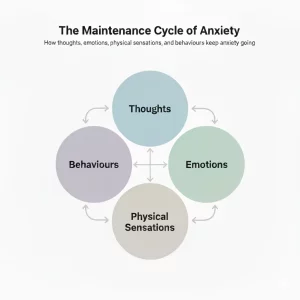
When a person suffers from recurrent, pervasive anxiety, it often continues through invisible patterns that quietly sustain it. These are known as maintenance cycles, repeating loops in which thoughts, emotions, and physical sensations influence one another and keep the experience of anxiety alive and growing.
Anxiety is not a single process that happens only in the mind. It involves the whole system: how we think, what we feel, and how the body reacts to these thoughts and feelings. A shift in one area can lead to changes in the others. Over time, these interactions can form a cycle that repeats itself automatically, making anxiety seem ever-present, unpredictable, and uncontrollable.
For instance, a physical sensation such as an increase in heart rate may lead to a worrying thought (“Maybe there’s something wrong with my heart”), which creates more intense emotional distress such as panic. This, in turn, heightens the physical sensation as the heart rate increases further. Each part of the system reinforces the next. For example, the thoughts may become more catastrophic (“I’m going to have a heart attack, I’m going to die”), and the body and mind become caught in a feedback loop that maintains and intensifies the anxiety.
Becoming aware of the patterns that keep anxiety going
These cycles often operate outside of conscious awareness. People can find themselves feeling anxious without fully knowing why, because the processes that keep anxiety going are subtle and interconnected. It’s not usually one single event or thought that causes the problem, but the ongoing interaction between them.
In therapy, you can develop the ability to slow this process down and recognise it when it is happening. Over time, you can become highly skilled at noticing the relationship between thoughts, emotions, and physical sensations. This turns what was once an unconscious pattern that affected you, but which you were probably unaware of, into something you are conscious of and understand well. This creates the opportunity to make different choices and small interventions that can disrupt the unhelpful maintenance cycle and allow you to begin taking actions that reduce your anxiety.
Taking back control from automatic anxiety patterns
This is the beginning of a deeply empowering way of understanding anxiety and how, through your own actions, you can begin to undermine the process and put yourself back in the driver’s seat. A process that was once automatic and negative, almost certainly leading to avoidance and other unhelpful anxiety-maintaining behaviours, can start to be dismantled.
To understand this more fully, we need to look at the branch of psychology known as behaviourism, which we will explore in the next article.