How Anxiety Narrows Your Attention
Many people think of anxiety as fear. A surge of panic, a racing heart, a sudden sense that something is wrong. But for many people, anxiety is quieter and more persistent than that.
A helpful way of understanding anxiety, including how it develops and is maintained is to think about what it does to your attention.
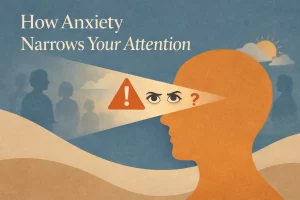
When anxiety is active, attention narrows. Your mind becomes focused on threat, risk, and what might go wrong. This happens automatically and often without you realising it. You are not choosing to focus this way. Your nervous system is doing it for you.
As attention narrows, certain things come sharply into focus. Possible danger. Uncertainty. Small signs that something might not be right. At the same time, other information fades into the background, including context, perspective, and signs that things may actually be safe or manageable.
This is one reason anxiety can feel so convincing. It is not just about the thoughts you have. It is also about what your mind allows you to notice.
When Attention Locks Onto Threat
You might recognise this in everyday situations.
For example, you walk into a room full of people. If anxiety is present, your attention may immediately scan for signs of judgement or rejection. A neutral facial expression. A pause in conversation. Someone not making eye contact.
These details stand out. They feel important. Your mind starts interpreting them, often quickly and harshly.
At the same time, other information is filtered out. Friendly faces. People who are distracted with their own thoughts. The fact that nothing overtly negative is actually happening.
Because attention is narrowed, the anxious interpretation feels like the full picture. It can feel as though you are seeing the situation clearly, when in reality you are seeing only a small and threatening slice of it.
This is not a flaw or a personal weakness. It is a survival response. In genuinely dangerous situations, narrowed attention helps us react quickly. It allows fast decisions and immediate action.
The problem arises when this same system switches on in everyday situations, such as social settings, health worries, or uncertainty about the future. In these contexts, narrowed attention does not lead to resolution. Instead, it often leads to overthinking, rumination, and a sense of being stuck.
Why Reassurance Often Does Not Help
When attention is narrowed, reassurance struggles to land.
You may understand logically that your fears are unlikely or exaggerated, yet still feel unconvinced. It can be frustrating and confusing. You might tell yourself that you should be more rational, more confident, or better at calming yourself down.
But the issue is not a lack of logic. It is that your attention is locked.
Trying to reassure yourself while anxious can feel like trying to see a wide landscape through a narrow tunnel. You know the bigger picture exists, but you cannot access it properly in that moment.
Over time, this pattern can become habitual. The brain learns that scanning for threat feels important, even when it is exhausting. Anxiety can begin to shape how you experience the world, making it feel more dangerous than it really is, not because danger has increased, but because attention has become trained to look for it.
Understanding Anxiety Differently
Seeing anxiety as a pattern of attention can be surprisingly relieving.
Instead of viewing it as a personal failing or a sign that something is wrong with you, it becomes something understandable. A process that makes sense given how the brain is designed to protect us.
Patterns of attention are not fixed. They can change. Not instantly, and not through force, but gradually, as awareness widens and flexibility returns.
When attention is able to move more freely, anxiety often loosens its grip. Situations can begin to feel different, not because they have changed, but because your mind is no longer locked onto threat alone.
For many people, simply understanding this process helps anxiety feel less mysterious and less overwhelming. It becomes something that can be noticed and worked with, rather than something that defines them.
I offer counselling for anxiety disorders, addiction issues and relationship issues in my Crouch End Office at The Vale Practice.