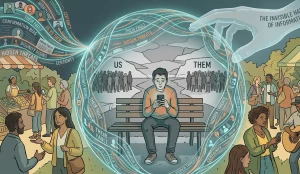
The Invisible Hand: How Our Information Supply Shapes Our World
In my work as a therapist, I often sit with people who feel a growing sense of unease. They describe a world that feels increasingly hostile, divided, and difficult to trust.
What is often happening beneath the surface is something we rarely notice. The information we take in is not just shaping what we think, it is quietly shaping what we experience as real.
There is something very old in us that makes this possible.
Psychology has shown how quickly human beings sort the world into “us” and “them.” In the classic experiments by Henri Tajfel, people favoured their own group even when the groups were created randomly. Similarly, Jane Elliott demonstrated how easily people can begin to treat others differently based on arbitrary distinctions.
This is often described as Social Identity Theory. Once we categorise, we tend to exaggerate differences and overlook shared humanity. This is not a flaw in a few people. It is a basic human tendency.
What has changed is the environment we are living in.
The Comfort of Certainty
Today, we are constantly exposed to streams of information, through news, social media, and online content, that are shaped by what we engage with. Over time, this creates a kind of personalised world.
Most people are vulnerable to being drawn towards information that confirms existing fears, reinforces a sense of moral clarity, and simplifies complex people into recognisable “types.”
This creates a powerful feeling of certainty. It can feel as though we are finally seeing things clearly, as though the world makes sense.
But there is a hidden cost.
From Information to Reality
Spending time within one of these information streams does more than influence opinion. It begins to shape perception itself.
Certain patterns stand out more. Some explanations feel obviously true. Alternative perspectives become harder to take seriously.
Over time, what begins as exposure becomes interpretation, and then something stronger. It starts to feel like reality.
When that happens, disagreement can feel unsettling or even threatening, not because of the content alone, but because it challenges the world as we have come to experience it.
The Loss of the Individual
One of the most significant consequences of this process is how it changes the way we see other people.
When we repeatedly encounter narratives about “groups,” especially ones that portray our group positively and others negatively, it becomes harder to meet individuals as individuals.
Instead, people can start to feel like representatives of a category.
In therapy, I see the human impact of this:
A young person who wants connection but feels it is too risky to trust.
A professional who assumes hidden motives in colleagues.
A quiet but persistent sense that people are fundamentally unsafe or unreliable.
The Human Cost: A Smaller Life
The real cost is not only division between groups. It is the narrowing of our own lives.
When certainty takes hold in this way, curiosity often fades. We become more guarded. We withdraw from situations that might challenge our assumptions.
The world becomes smaller.
There is often a paradox here. People can feel very certain, even “right,” while also feeling more isolated, more anxious, and less connected.
Why It Is Hard to Let Go
These ways of seeing the world can feel protective. If people can be categorised, they become more predictable. And predictability can feel like safety.
But predictability is not the same as connection.
Real connection requires a willingness to tolerate uncertainty. It involves meeting people who may not fit neatly into the categories we have learned.
Finding a Way Back
The first step is not to reject all of our views or ignore real problems in the world. It is simply to notice the process.
To ask:
Is my world feeling bigger or smaller?
Am I becoming more curious about people, or more certain about them?
What is the emotional cost of the certainty I feel?
We cannot completely step outside our human tendencies. But we can become more aware of them.
And in that awareness, something important becomes possible again.
A return to complexity.
It is in that complexity that we find space, for curiosity, for connection, and for a life that feels less constrained by fear.